
Sex Offender Checks in Harrisonburg City
The primary channel is the Virginia State Police Sex Offender Registry. It is free to the public and includes search, map, profile, resource, and alert functions. Start there for an address, name, SOR number, ZIP code, or locality search. Search Harrisonburg City as the locality because it is legally separate from Rockingham County. Then search the surrounding county when the place of concern lies near the city boundary or a trip crosses both jurisdictions.
A registry result answers a narrow question: what registration data Virginia law makes public now. It is not an HPD incident report, a court docket, or an official CCRE criminal-history product. Dates, aliases, offense details, and address status help distinguish a result. If the concern is a suspected registration breach, do not investigate or confront the person. Preserve the public information and contact law enforcement or the VSP registry unit.
Plan the search around a real place or a known identity, not a broad assumption. For a name check, try the spelling shown on an official paper and then review aliases. For place awareness, check the full street area and nearby ZIP codes. A person may work or study in one locality while residing in another, and the visible profile fields depend on what Virginia law publishes for that status.
Harrisonburg Registry Locality Choice
The most common local search error is treating Harrisonburg as a city within Rockingham County. Virginia recognizes Harrisonburg as an independent city and county-equivalent. A county-only filter can therefore omit a Harrisonburg record even though many local justice agencies use a shared Harrisonburg/Rockingham name. Run the Harrisonburg locality search first, then add Rockingham County as a separate nearby search when needed.
The official VSP registry home screen shows the registry's search and map entry points.
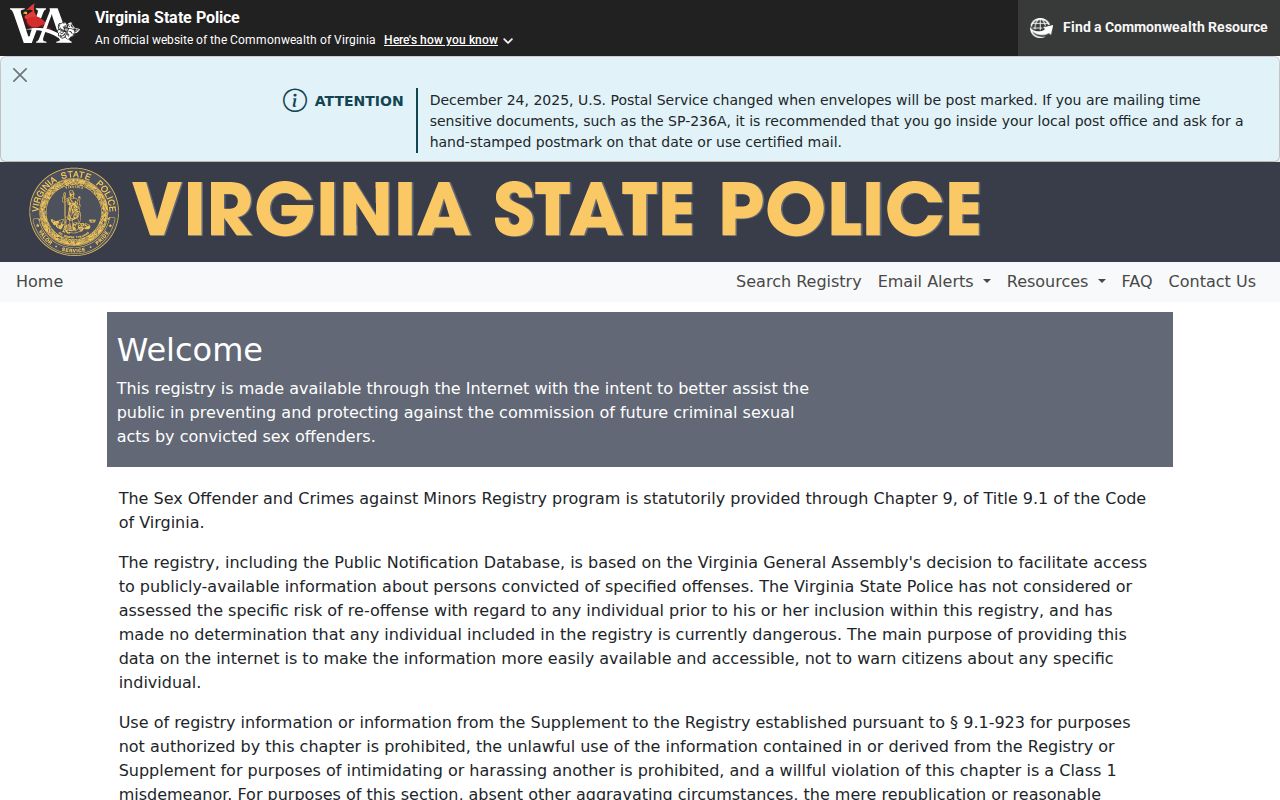
The screen makes the place-based route visible before a user opens any individual profile.
How to Search the Virginia Registry
The redesigned registry supports several ways to narrow a Harrisonburg City sex offender search. Choose the field that matches the soundest fact you have. An SOR number is a direct identifier, while a name may need review of aliases and physical details. An address, ZIP, radius, or map view is better suited to awareness around a place. Exact radius choices should be read from the live form because the official research did not reliably expose the current distances.
- Open the Virginia registry and read its conditions and safety notice.
- Enter a name or SOR number, or choose an address, ZIP code, city, or county route.
- Select Harrisonburg as an independent city and use map, radius, or status filters when useful.
- Open a likely profile and compare identifiers, address status, offense data, tier, and compliance information.
The official registry search form supplies these controls.
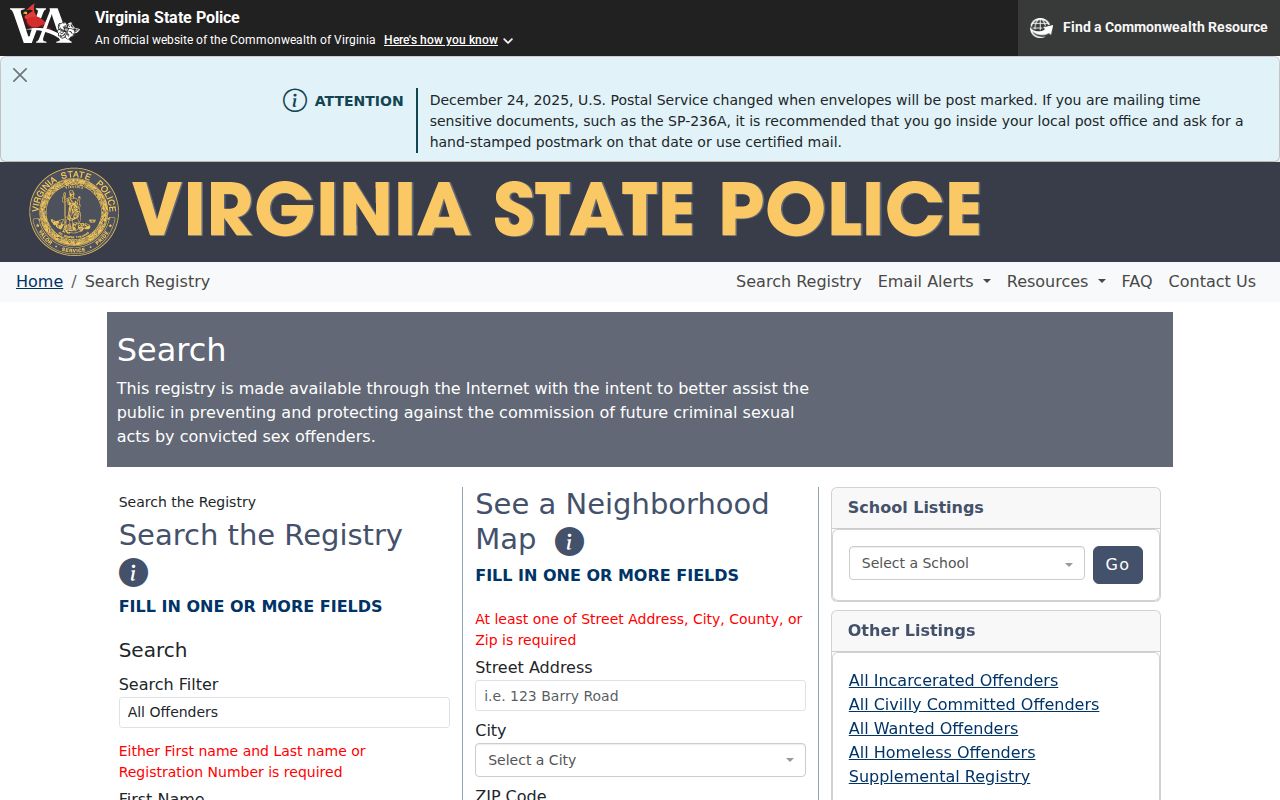
Those fields support both identity-based and geography-based checks without relying on a commercial people-search service.
| Field or control | Type | Required | Use |
|---|---|---|---|
| Name | Text | No | Search an offender name and review aliases |
| SOR Number | Text | No | Use a direct registry identifier |
| Address, City, County, ZIP | Text or selection | No | Search Harrisonburg or a defined place |
| Radius | Selection | No | Map an area around a location |
| Map or List | View control | No | Change how matching records appear |
| Incarcerated, Homeless, Civilly Committed | Filters | No | Include advertised status categories |
| Search or Clear | Buttons | Operational | Run or reset the criteria |
Harrisonburg Registry Search Changes
Virginia State Police launched the redesigned registry on October 31, 2023. Its July 2024 CJIS newsletter described added searches by ZIP code, address, SOR number, city, and county, plus radius and contiguous-area mapping. It also identified incarcerated, homeless, and civilly committed categories. These additions matter in Harrisonburg because an ordinary county filter does not describe the independent city's legal status.
The newer interface also puts profiles, maps, resources, and alert functions in one state-operated system. A result may change as an address or status is verified. Record the date of a safety check and return to the live profile instead of treating a saved screen as permanent. A profile is a snapshot of public registration data, not a live account of where someone is at each moment.
Map pins also need care. They help define an area, but the profile text is the source for the published address or status. Open the record, compare its identifiers, and use the state contact when a map and profile appear to conflict.
Inside a Registry Profile
A public Virginia profile can help confirm whether a result matches the person or place being checked. Read the full set of available identifiers rather than relying on a name or photograph alone. Some details vary with the person's status and the statutes that govern public display. The offense line reflects a conviction tied to registration, while the address line may instead show homeless, incarcerated, or another listed status.
| Name and aliases | Legal name and other names published for identification |
|---|---|
| Photo and description | Current image plus available age or birth-year, sex, race, height, weight, hair, eyes, and identifying marks |
| Address or status | Residential information or a status such as homeless or incarcerated |
| Offense details | Description, jurisdiction, conviction date, statute, and registration basis when public |
| Tier | Virginia's offense-based statutory classification |
| Other public fields | Possible work, school, vehicle, compliance, and verification information |
Tier is not a present-day risk score. It is a legal classification tied to the qualifying offense and registration rules. The registry is also not a complete criminal record. Court portals provide filed cases and outcomes, while CCRE supplies Virginia's controlled criminal-history product.
Harrisonburg and Cross-State Registry Search
Harrisonburg sits on Interstate 81, and daily travel can cross city, county, and state lines. The U.S. Department of Justice National Sex Offender Public Website is the official cross-state supplement when a search extends beyond Virginia. Use it after the Virginia registry, not as a reason to skip the more detailed state profile and locality controls.
The federal site's official entry screen illustrates that national search layer.
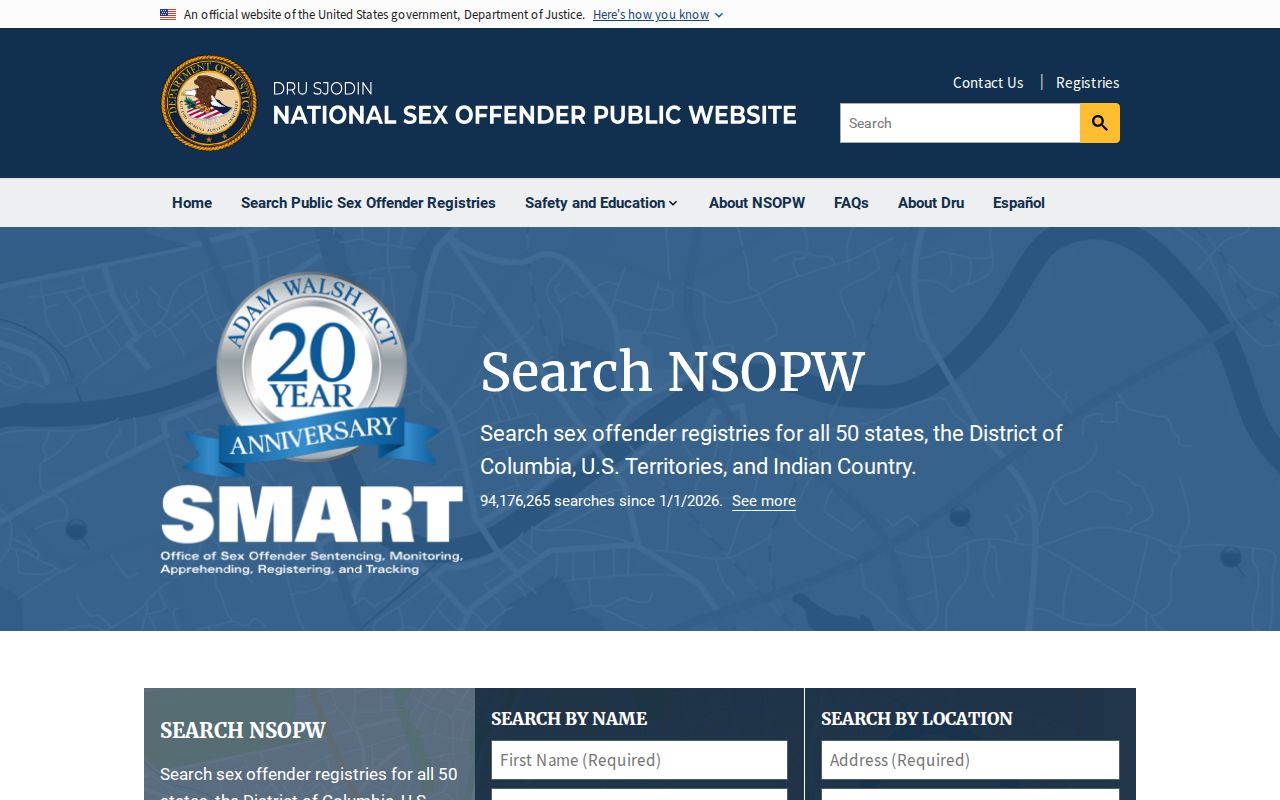
A national match should be confirmed on the source jurisdiction's live registry because each state controls its own public fields and updates.
Virginia Registration Levels and Requirements
Virginia assigns tiers by the offense categories in the Sex Offender and Crimes Against Minors Registry Act. The legal duration comes from Virginia Code § 9.1-908, while an eligible person may seek removal under § 9.1-910. Duration and the interval for re-registration are separate issues. A failure-to-register or false-information conviction can increase the reporting interval and extend the term.
| Tier | General concept | Duration and verification | Public visibility |
|---|---|---|---|
| Tier I | Lowest statutory offense tier | Duration and removal follow § 9.1-908; compliant registrants returned to annual re-registration in 2025 | The public profile shows the fields Virginia law authorizes for the person's current status |
| Tier II | Intermediate enumerated offenses | Annual when compliant; twice yearly after a relevant failure or false-information conviction under the 2025 change | Public fields follow the Registry Act and can vary by record and status |
| Tier III | Most serious enumerated or sexually violent offenses | Generally lifetime registration with more frequent verification under the Act | Public visibility remains statute-based and does not make the tier a live risk score |
Federal SORNA terms should not be used to guess a Virginia result. The exact state offense and statutory classification control. A court disposition or registry official can resolve a question that the public profile does not answer.
Harrisonburg Registry Timing After 2025
A state law change effective July 1, 2025 restored annual re-registration for compliant Tier I and Tier II registrants. Virginia State Police reported mailing 4,560 notices and updating its forms and site. Tier I or II registrants with a qualifying failure-to-register or false-information conviction re-register twice each year. This change affects the duty schedule, but it does not turn a tier into a risk forecast.
The shared Rockingham County Sheriff's Office is the likely local law-enforcement contact for registration in the Harrisonburg area. Confirm the appointment location at 540-564-3800 before going. Questions about the public state record can go to the VSP Sex Offender Registry at 804-674-2825 or sor@vsp.virginia.gov. A suspected breach should be reported through those official channels.
Harrisonburg Registry Alerts and SP-285
The public registry advertises alert functions, but VSP Form SP-285 is a different and limited notification route. It is not a general household email signup. The form is designed for statutorily eligible schools, licensed or regulated child-care institutions, foster homes, family day homes, group homes, and similar entities in the same or a contiguous ZIP-code area.
SP-285 asks each listed facility to choose internet or postal notice, then provide an email address, facility name, contact person, mailing address, ZIP code, and telephone number. It is mailed to CCRE's Sex Offender and Crimes Against Minors Registry Notification Request in Richmond. Residents seeking ordinary community awareness should use the registry's public alert controls and verify the available settings on the current site.
Community Notification and Lawful Use
Registry information is intended for public awareness and safety planning. It can support a calm review of a home, school route, park trip, or neighborhood area. It does not authorize contact, surveillance, threats, or a targeted dossier. Virginia also has specific school and property provisions in §§ 18.2-370.2 through 18.2-370.5, not one universal rule that every registrant must live a fixed distance from every park or school. Court orders and supervision conditions can add limits for an individual.
Misuse is a crime: Virginia Code § 9.1-912 prohibits using registry information to intimidate or harass; the SP-285 notice identifies that conduct as a Class 1 misdemeanor.
Report suspected noncompliance to law enforcement or VSP. Do not confront the person listed. A mismatch, stale address, or question about a profile should be directed to the registry unit so the agency with authority can review it.